Key takeaways
- Your brand is the whole impression you make, not just your logo.
- Settle your logo, colours and fonts before you build a website or order print.
- A one page branding guide keeps everyone who designs for you consistent.
- Consistency across website, print and social media builds recognition and trust.
- Rebrand when the business changes, not when you’re tired of the logo.
Branding is more than a logo
When people say “branding”, they often mean the logo. The logo matters, but it’s only one piece. Your brand is the whole impression people take away: how your website looks, how your signs and business cards feel, the words you use and how you treat customers.
Small businesses have an advantage here. You are the brand, and you can make it consistent much more easily than a large company can. If you want the longer explanation, my guide on logo vs branding breaks down the difference.
The core branding elements
For most small businesses, these branding elements cover nearly everything:
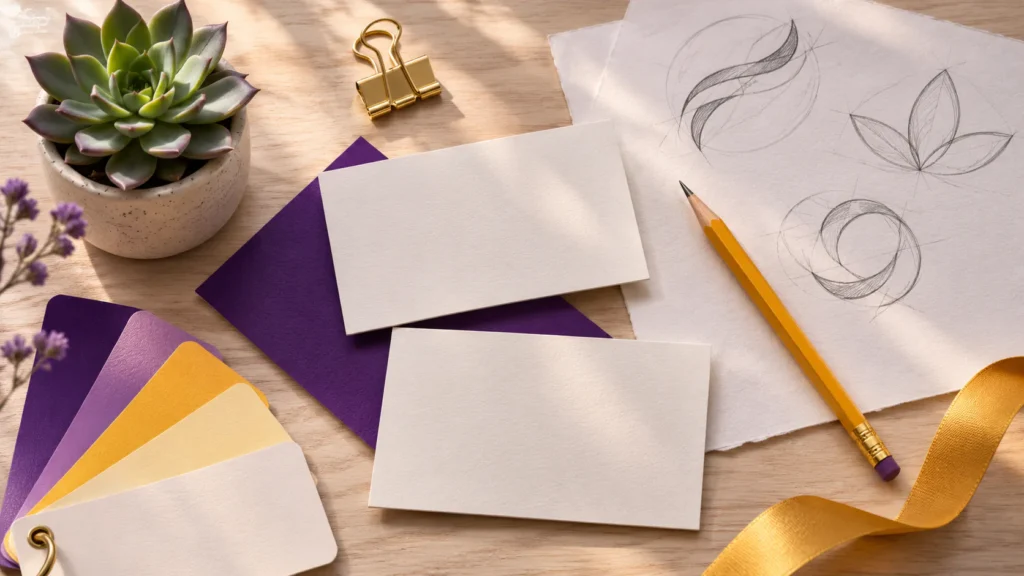
- Logo, with a main version plus simpler versions for small spaces and social media icons.
- Colour palette of two or three main colours and one or two accents, with exact colour codes.
- Fonts, usually one for headings and one for body text.
- Photography style: bright or moody, people or places, posed or candid.
- Voice: how you sound in writing. Friendly and plain? Formal and precise?
- Key message: one sentence that says what you do and who you do it for.
You don’t need all of these on day one, but the logo, colours and fonts are worth settling before you build a website or order print.
My branding process, step by step
The branding process steps I follow are the same whether it’s a new clinic or a long-standing farm business:
- Discover. We talk about your business, your customers, your competitors and what makes you different.
- Plan. I gather references and agree on a direction with you before drawing anything.
- Design. I create logo concepts in Illustrator and show how they look in real settings, like a sign or a website header.
- Refine. We adjust the chosen concept until it feels right.
- Launch. You get final files for print and web, plus the colours and fonts that go with them.
For Anchor Health Centre in Digby, that meant a nautical logo that suited a coastal clinic, followed by a website and marketing material that all used the same look. The details of how I approach logos are in my logo design guide.
Create a one page branding guide
Large companies have thick brand manuals. A small business needs one page. A one page branding guide should include:
- Your logo versions and when to use each one.
- Colour codes for print (CMYK) and screen (HEX or RGB).
- Your heading and body fonts.
- Two or three sample photos that show your style.
- A few words that describe your voice, plus a few to avoid.
Keep it somewhere easy to find and send it to anyone who designs for you: the sign maker, the printer, a staff member making social posts. It’s the simplest way to stop your brand drifting over time.
Be consistent everywhere
Consistency is the branding best practice that makes the biggest difference. When your website, business cards, brochures and social media all look like they belong together, people remember you and trust you more.
A good example is Valley Family Fun, where I redesigned both the logo and the website so the whole presence felt like one community resource. A quick check you can do today: line up your website, your business card and your last social post. Do they look like the same business?
Branding tips for small businesses on a budget
- Start with a simple logo. A clean, text-based logo can look very professional. Mine start from $300. The logo cost guide explains what affects the price.
- Limit your colours. Fewer colours look more confident and cost less to print.
- Use real photos. A few good photos of you, your team and your work beat any stock library.
- Write like you talk. Plain language is easier to read and easier to keep consistent.
- Don’t rebrand too often. Refresh when your business has genuinely changed, not because you’re bored of your logo.
Branding mistakes I see often
- Too many fonts. Three or four fonts on one flyer make a business look unsure of itself.
- Low-resolution logos. A blurry logo pulled from a website and stretched onto a sign undoes everything else. Keep your original vector files safe.
- Copying a competitor. Looking like the biggest business in your area makes you forgettable, not credible.
- Following a trend. Trendy gradients and fonts date quickly. Aim for something that will still feel right in ten years.
- Forgetting the words. A polished logo next to a vague tagline sends mixed signals. Your key message deserves as much care as your colours.
Most of these are easy to fix once you notice them. Start with the one your customers see most often, which is usually your website or your sign.
When to get professional help
If your logo was made in a hurry, your colours change from one flyer to the next, or your website doesn’t match your print material, it may be time for a proper brand. My branding and identity service covers logos, brand guidelines and the marketing material that goes with them, and you work with me directly from the first sketch to the final files.
Frequently asked questions
What are the main elements of a brand?
Logo, colour palette, fonts, photography style, voice and a short key message. Together they shape how people recognise and remember your business.
What should a branding guide include?
For a small business, one page is enough: logo versions, colour codes for print and screen, fonts, sample photos and a few words describing your voice.
How often should a small business rebrand?
Only when the business has genuinely changed, such as a new name, new services or a new audience. A light refresh can keep a good brand current without starting over.
Do I need a logo before I build a website?
It helps a lot. Your logo sets the colours and fonts the website will use. If you need both, I can design them together through my web design and branding services.